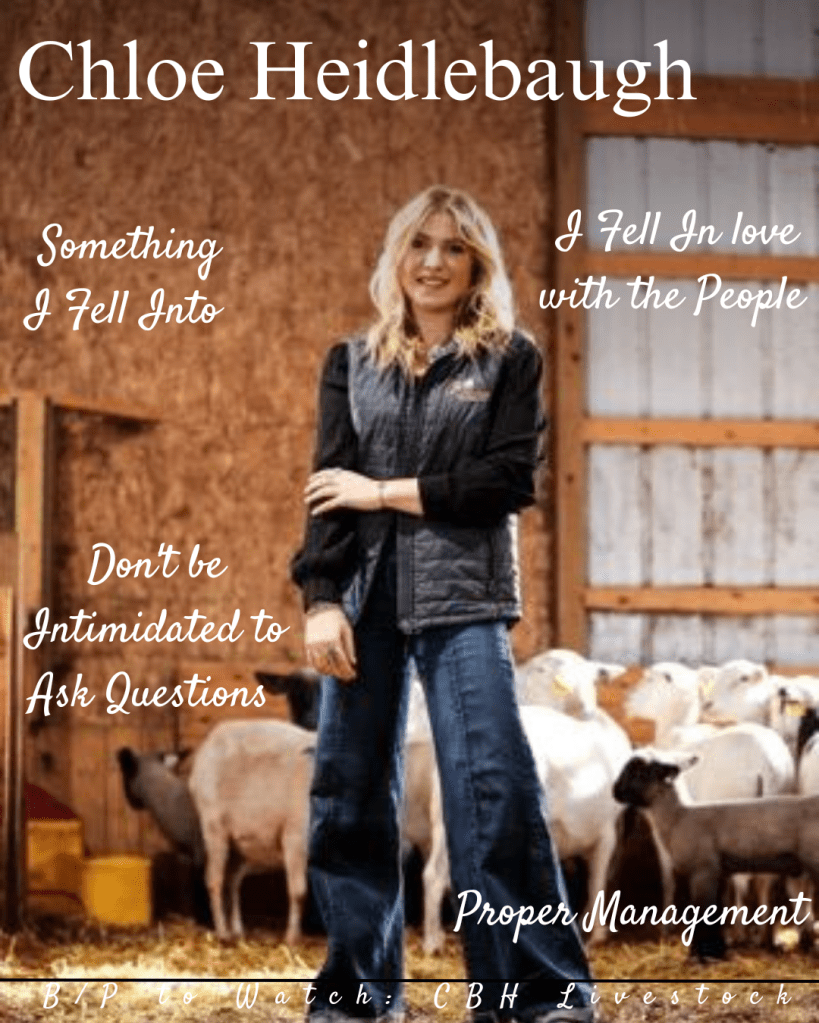
CBH Livestock, is operated by Chloe Heidlebaugh. Chloe was not raised in the show industry but grew up on a commercial grain farm. She was very involved in 4-H and FFA which is what led to her showing career and her decision to create CBH Livestock. Chloe has been focusing on learning and expanding her knowledge in the industry to help her develop CBH Livestock into something more.
“My name is Chloe Heidlebaugh and I am 22 years old, originally from Findlay, Ohio.”
For Chloe her journey didn’t begin by showing but through being involved in agriculture through other things. Her family is a long line of commercial grain farmers which led to her love for agriculture – which is where she would find her true calling.
“My journey in the industry began very unconventionally because I did not come from a livestock family. I was heavily involved in 4-H and FFA and that was where my introduction into the show lamb world began.”
Chloe began showing feeder lambs at the county fair at eight years old. “I was the definition of a 4-H freddy.”
She continued showing feeder lambs and feeding out freezer lambs up until COVID hit in 2020. During COVID Chloe bought her first true show wether. Which is when she began showing at jackpots due to the county fair being cancelled that year.
“I was immediately hooked. After I had that wether- in December of 2021, I bought my first show ewe and campaigned her at jackpots all across Ohio and showed at the Ohio State Fair for the first time. She gained me a lot of grand drive appearances and even placed 4th in her ewe class at OSF. I kept her and she became the start of my flock in 2022, which is when I also met the crew at Sugarcreek Club Lambs. They took me under their wing and allowed me to show their ewes my last year. In the Summer of 2024, I moved my flock to their facilities so they could be managed and bred while I was away on my internship in Iowa, with Hild Brothers Show Stock. Which is to credit many of my management skills too.“
“CBH Livestock stemmed from an FFA project gone awry (also due to the fact that I had developed such a strong bond with my first show ewe that I couldn’t let her go).” Owning her own operation wasn’t something Chloe had planned and it didn’t become serious until about two years ago.
“Raising show lambs was something I fell into as I got exposed to more of the breeding side of the industry. My experiences as an intern for Hild, and working as a flock manager for Sugarcreek Club Lambs, my collegiate judging career, and the connections and opportunities gained from all of those experiences. Was what pushed me to fall in love with the industry and want to grow my operation to be more influential.”
Chloe had no name, mentors, or connections and in Ohio, you can’t show past 18 years old so when Chloe’s show career came to an end. She didn’t know how to stay involved in the industry.
“I felt like I had been robbed from experiences because I didn’t have any younger siblings or nieces or nephews who could show.. But I fell in love with the people in the industry and what showing livestock teaches youth. So I saw starting an operation as a way to stay involved in the industry with the goal of giving back and helping kids with situations similar to mine.”
CBH is just Chloe’s initials which she says, “is kind of boring.” When people hear the name CBH Livestock Chloe wants people to associate CBH Livestock with everything she has tried to build her brand around: honesty, integrity, and high quality livestock.
“I think honesty and integrity is essential when building a brand especially when trying to make a name for yourself…it’s what adds to your credibility to your character and your reputation as a breeder. You don’t need an established name to start something successful, you just need a good reputation. As far as the livestock goes — I strive to use reliable and proven genetics that create a consistent phenotype that will create genuine, functional lambs that are still on trend with the industry. Livestock that’s genuine and competitive raised by an honest breeder is what I want people to think of when they hear the name ‘CBH Livestock’.”
For Chloe her lack of education and being afraid to ask for help-was her biggest challenge.
“I was very much in over my head in my first year. I used the cheapest semen I could buy for AI, I had never lambed out a ewe before, I had no customers established, and had made no connections in the industry at that point. I think I only sold 2 out of the 7 lambs I had to county fair showmen my first year, and neither of them were very good either. Needless to say, I was discouraged and learned almost every single lesson the hard way because I was uneducated and too intimidated to ask for help. But perseverance and having an open mind was what helped me overcome that.”
After a rough first year, IChloe began to get over her fear of asking questions and she finally reached out to different local breeders. “Those conversations were a huge learning point for me.” Chloe is also an Animal Science major at Ohio State and was a member of both a junior collegiate and collegiate livestock judging team. The things learned from those experiences helped Chloe realize the importance of proper management and genetics in her own flock. “So in year 2, I put those learned concepts in action and took a gamble in buying a breed ewe who possessed the genetic lines I had become interested in. That bred ewe has become the cornerstone of my flock and was arguably the best thing that happened to my program at that point.”
“Raising good livestock starts with good management and good genetics.”
“Genetics will either make or break a program and oftentimes determine over 50% of the value of the animal and management is what allows those genetics to excel.” Chloe prioritizes maintaining a consistent genetic line while utilizing relevant and proven sires. Her criteria for raising lambs is genuine muscle shape/dimension, skeletal integrity, functionality, fertility, and mothering ability in ewes.
“At the end of the day I choose genetics based on what I think will create something I am proud to look at when I go out to do chores everyday.”
Chloe did not start CBH Livestock or her show career with a name or any well known connections. “Honestly you don’t need a name to become successful.” Chloe is a believer that with hard work, dedication, a willingness to learn, and integrity anyone can become successful if they put their mind to it. For Chloe reputation and developing an operation known for quality are interconnected. “From a young age my parents instilled in me that the only thing you have when you’re gone is your reputation. That goes back to the principle of treat others how you want to be treated. Anytime I have bought from other breeders, or done business in general, I chose to do business with people I think have integrity. I am honest with them in my intentions and open in communication. I think that has served me very well as that has been reciprocated and I have been able to build relationships with other industry professionals that have helped me further my operation.”
As CBH Livestock continues Chloe is most excited about growing more relationships with customers, other breeders, and showmen. “Connections matter, and maintaining good industry relationships is crucial when trying to place sheep in good homes. I didn’t start this venture with a name so in the beginning finding customers was hard. But looking back on the progressive support my program has received in just a few years is very humbling, and I am very excited to continue to grow my customer base and maintain good relationships with those who have supported me. Connections and will always take you further ahead in life, that goes with anything. Really that falls back to the principle of ‘treat others how you want to be treated’ so I want to expand upon that and grow my customer base in an impactful way.”
Chloe’s goals for the next few years with CBH Livestock is to continue to work on her whiteface division that she just started. She has 2 donors in her flush program and hopes to expand.. By the end of this year Chloe plans to grow her flock to 25 head after graduating from college in May. After graduation she hopes to continue focusing more on her operation.
“By next year my goal is, I would like to double the amount of donors in my flush program as well as double my flock to 50 head, or as big as I can get it. One unique goal I have for my flock is to start my own flock of dorper/katahdin crosses for dual purpose as recips to stay in house and hot house commercial market lambs. Long term my goal for my operation is to become integrated with my family’s grain farm and operate at a larger scale with developing a fully integrated house flush program while maintaining the same values I started this operation with.”
Chloe’s advice to anyone wanting to start their own operation comes down to 3 main things:
“1. Be open minded – Be willing to have conversations and learn from established breeders. 2. Don’t be intimidated to ask questions, no question is dumb. Be willing to make mistakes and treat them as a learning opportunity. 3. Research management practices, research different feed rations, research genetics and then try implementing that research in your operation”

