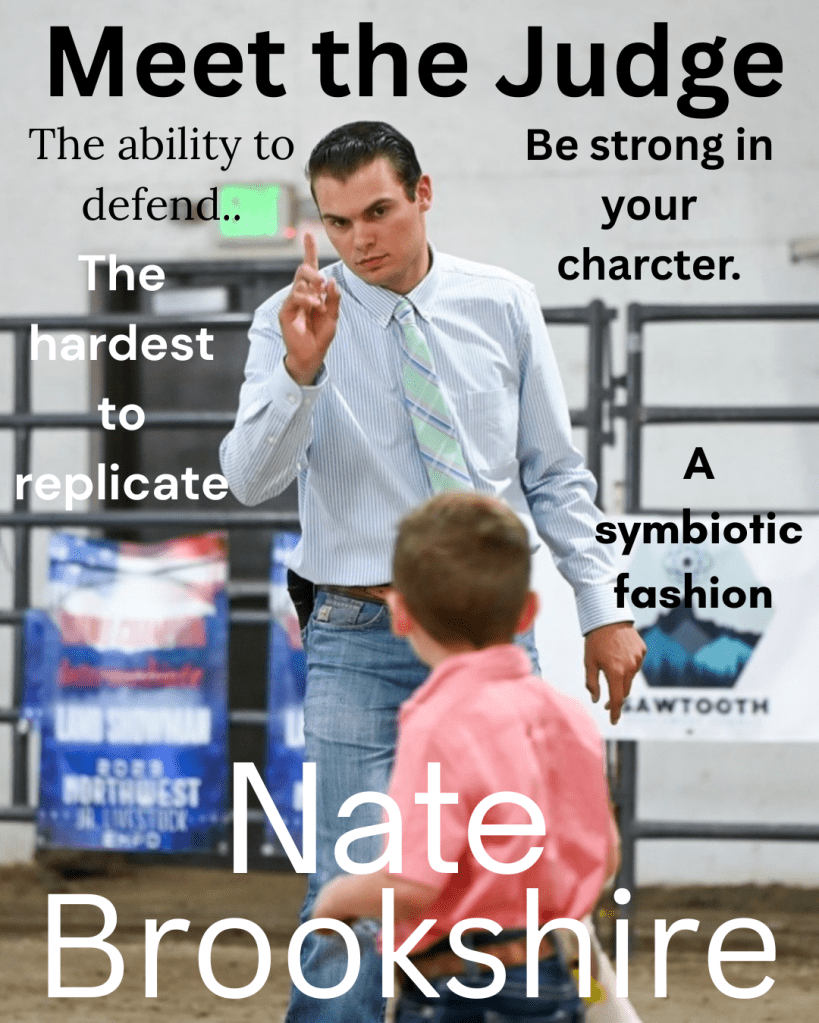
Nate currently serves as special faculty at the University of Illinois where he is an instructor and a livestock judging coach. Beyond the classroom he is also the owner and operator of BK livestock with his family, he also is a partner of Coalition Show Stock with his best friend and his family.
“My name’s Nate Brookshire, I am a 24 year old California native, that now resides in Central Illinois. I love raising and working and working on show stock, coaching judging teams, sorting junior stock shows, and being with friends and family.”
Unlike many, Nate wasn’t born directly into the show industry. However, his family had always had a deep tie to agriculture, which later led to his journey into the show industry. He played competitive sports like baseball and basketball, and decided to take an AG class in high school, which quickly led him to fall in love with livestock judging.
“I decided to take an AG class in high school, and that really changed me a lot.”
“Around the same time, I also joined 4H,and raised my first sheep project. I had an incredible group leader, Gary Kincaid, who now I call dad.”
Nate didn’t immediately see himself as a livestock judge. But with a little push he joined and found a passion that has shaped his career.
“When I started high school I had an AG teacher that pushed me to join the livestock judging team. It only made sense to do livestock judging since my mom had judged throughout college. Soon I caught the bug and that was it.”
Nate’s college judging career began at Lake Land College, under coach Hayden Wilder. Before he transferred to Western Illinois University where he was coached by Dr. Mark Hodge.
“Both of my coaches are incredible role models, and people that I look up to. Some of the best years of my young life so far.”
Nate’s story is a reminder that the right influences and the right opportunities can change the entire course of your entire life.
Collegiate livestock programs offer an incredible opportunity to learn so many things. As Nate has continued his journey of livestock judging he believes that collegiate livestock judging is the best way to learn soft skills, such as public speaking, dedication, work ethic, and mostly the ability to defend your decisions in the ring and out.
“The ability to make a decision with conviction and defend it. In my opinion,it makes products of such programs highly employable beyond their degree. In Tandem, you get to travel the country with a group of people that you become very close with and get to see great livestock.”
“Nothing gets my blood pumping up like a critter that looks like God spent a little extra time on them.”
For Nate, judging always comes back to the basic fundamentals- body, build, and balance. But what really excites him are the outliers: nothing stands out more than an animal that’s hard to replicate.
“When I judge, I strive to pick the most unique animal, the one that feels the hardest to replicate. Of course, that animal must go beyond covering those basic fundamentals that I hold sacred. But I love crazy athletic, wild, looking livestock, with big rib cages and Arnold-like muscalarity.”
As the industry continues to grow, Nate believes the future depends on both holding to the tradition and reaching beyond.
“ I think the industry is incredible. I think that as an industry we need more people outside of it, to see the positive impact that the livestock industry has on youth. In my opinion we as an industry need to promote larger development of livestock literacy and understanding for those who are not brought up in rural roots.”
Nate, has noticed that too often, judges create negativity when evaluating animals, instead of highlighting the positive qualities of both the livestock and showman.
“As a positive person who was trained by very positive evaluators, I simply prefer judges who are positive in their comments about the livestock and the showmen.”
Nate admits that in the ring his passion and excitement for these animals can get the best of him.
“Sometimes I get so pumped up that I get a little tongue tied.”
When it comes to showmanship, everyone has their take on it. Nate says “it’s imperative to watch a couple of classes.” Understanding the ring and how it works is key to showmanship.
He also believes that showmanship should come down to the individual exhibitor.
“ I think showmanship should be a solo competition, and the only thing the showmen should focus on is presenting their animal to the best of their ability.”
Well presented animals can go a long way in showmanship. While being able to be symbiotic with your animal can go a long way.
“Having a well-presented animal that works in a symbiotic fashion with the exhibitor is very important when I judge. I know that each judge has a preferred style, but I would say that I am open to different approaches if the showman is efficient, intense, and the animal responds positively.”
Nate has been fortunate to step into the ring at some big shows, and those moments have left a mark.
“I have been blessed with the opportunity to sort a few shows that make this decision very challenging, however the Kentucky State Fair Market Lamb Show this year was a surreal moment for me. The stock was bad to the bone, the showmen were phenomenal, the show ran perfectly smooth, and the grand drive gave me chills. One that I will think about and reminisce for a while.”
Nate leaves us with this:
“My biggest piece of advice to a young judge is to be strong in your character. Take every opportunity that you can, make sure to highlight the kids, and the livestock positively. Thank the people that help you as often as possible.”

