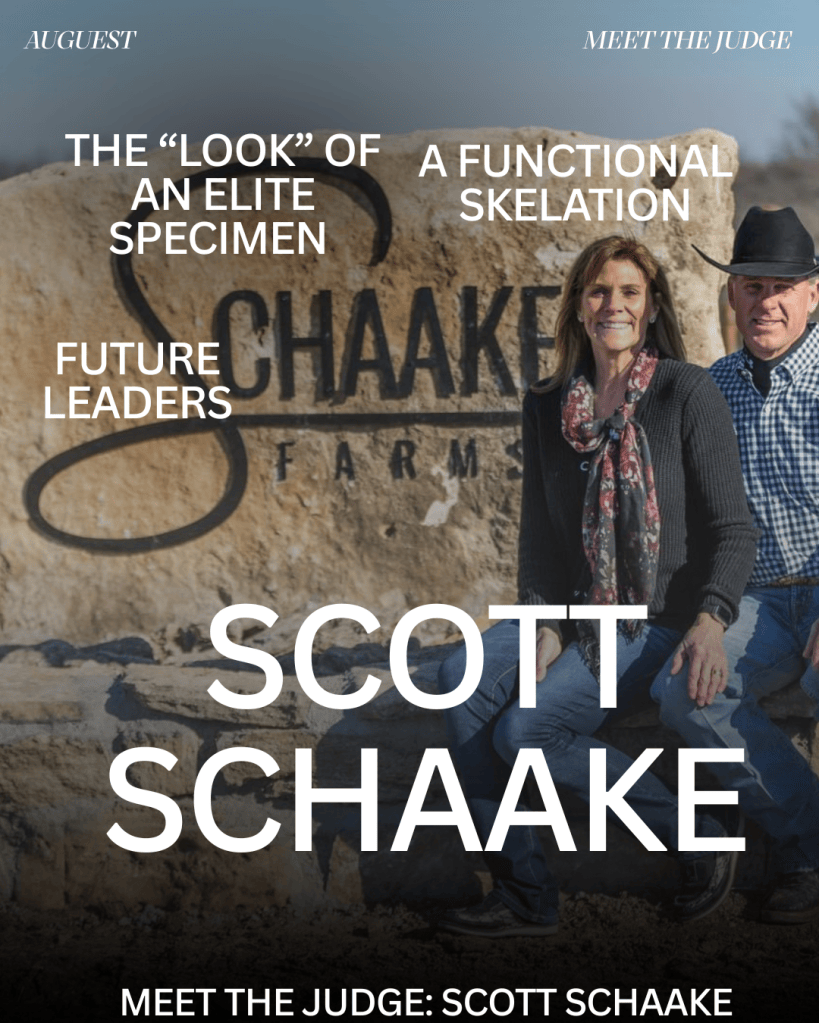
Scott SchaakeScott Schaake is your sheep judge as he is about to step into the ring at the 2026 Indiana State Fair Market Lamb Show. He and his wife, Kandi, currently live in Westmoreland, Kansas. Both are retired from education and now are full time ranching in the Flint Hills of Kansas. Scott and Kandi host 3 annual purebred Simmental sales each year. They sell 80-100 open show heifer prospects, and bred heifers in the fall, plus 80+ bulls in the spring.Scott grew up on a diversified farming/ranching operation in eastern Kansas. “We primarily focused on corn and soybeans, while doing feeder hogs, cattle, and ran a commercial cow-calf operation for many years.” The family farm is a major part in Scott’s life along with the row crops. They operate a 35 acre U-pick pumpkin operation. While still focusing on both purebred and commercial cow-calf operations. As a kid, Scott showed in his home state of Kansas. This led to having the opportunity to watch and learn from many of the legends in the judging circle. “As a younger 4-H member in Kansas I was exposed to some of the legendary judges of all time. Dr Don Good, Dr Miles McKee, Dr Calvin Drake, Dr Bill Able, and Joe Lewis to name a few.” From the start, Scott was exposed to some major judges that he learned from and studied through the years. “At 10 years of age I spent the entire week at the county fair watching judges sort through livestock. I listened to their explanations and I became instantly hooked on the responsibilities of these professionals. My parents were always challenging me to participate in speaking competitions at a very young age and my second year of 4-H included my mother taking myself and 2 other 4-H members to all the judging contests within a 100 mile radius of our farm. We were self-taught judges and eventually the 3 of us went on to win our state 4-H contest and experienced our first trip to the NAILE judging contest.”Scott went on to judge at Kansas State University. Here he learned how to properly sort and evaluate livestock. “My first and perhaps only goal when I enrolled at Kansas State University was to become a member of both the meats and livestock judging team. I was fortunate enough to have been coached by the best and I enjoyed success on both teams. No question, those coaches and the judging team experience shaped me to who I am today and my tenure as a collegiate judging team coach for 28 years.”When it comes to Scott’s judging philosophy, he values one main focus: A Functional Skeleton. “My philosophy for livestock evaluation has never changed. Even though trends will contribute to the final placing of the animal, I have always had the opinion, regardless of the species, that the look of a champion must be based around a sound functional skeleton. With 60 years of livestock production I have recognized that in real world environments skeletal correctness is just as important in market animals as it is in breeding livestock.”“People have often asked what I consider most important when evaluating all species of livestock. My answer is pretty simple…. I’m not a fan of freaks nor single trait selection and I consider myself a greedy judge that wants the champions to be good in several traits. Those animals that excel in several traits are the tough ones to raise…… History has proven that freaks and single trait selection generally creates problems down the road.”Scott says that the animal with several good traits will always rise to the top for him. Those good traits can often vary for each judge. For Scott, the traits that he likes the most is a youthful look, in an athlete. “I consider myself old school when it comes to my approach in the show ring. A champion needs to be youthful, fresh, athletic and have the “look” of an elite specimen. I want to be proud of the champion when we head to the back drop.”Looking at the trends in today’s show ring, Scott often wishes some real world principles would be incorporated. “I wish some real world principles of livestock production could be incorporated into the decision but unfortunately the animal in today’s show ring does not replicate our goals in modern production.”“The most important thing that comes out of our youth shows today is the development of future leaders.”Scott sees in the ring the ultimate goal should not be the banner but to raise future leaders in the industry. “Few platforms today teach responsibility, work ethics, integrity, and financial obligations like livestock shows do. In 2026, for our family the livestock program was an activity in which we all shared responsibilities and considered the shows we attended as our vacation. I cannot imagine raising my family in a better environment than what our current youth shows provide. The ribbons and banners will someday be forgotten but the skills developed will last a lifetime. Our good friend, Warren Beeler, says it best…”Never let the banner become more important than the child.” I look forward to judging the classes at the 2026 Indiana State Fair.”

